Is The Dying Earth Still Worth Visiting?
Jack Vance’s 1950 fantasy classic was vastly influential and beloved by a generation, but does it hold up under the hype? What can modern fantasy learn from a book written in a time before Tolkien?
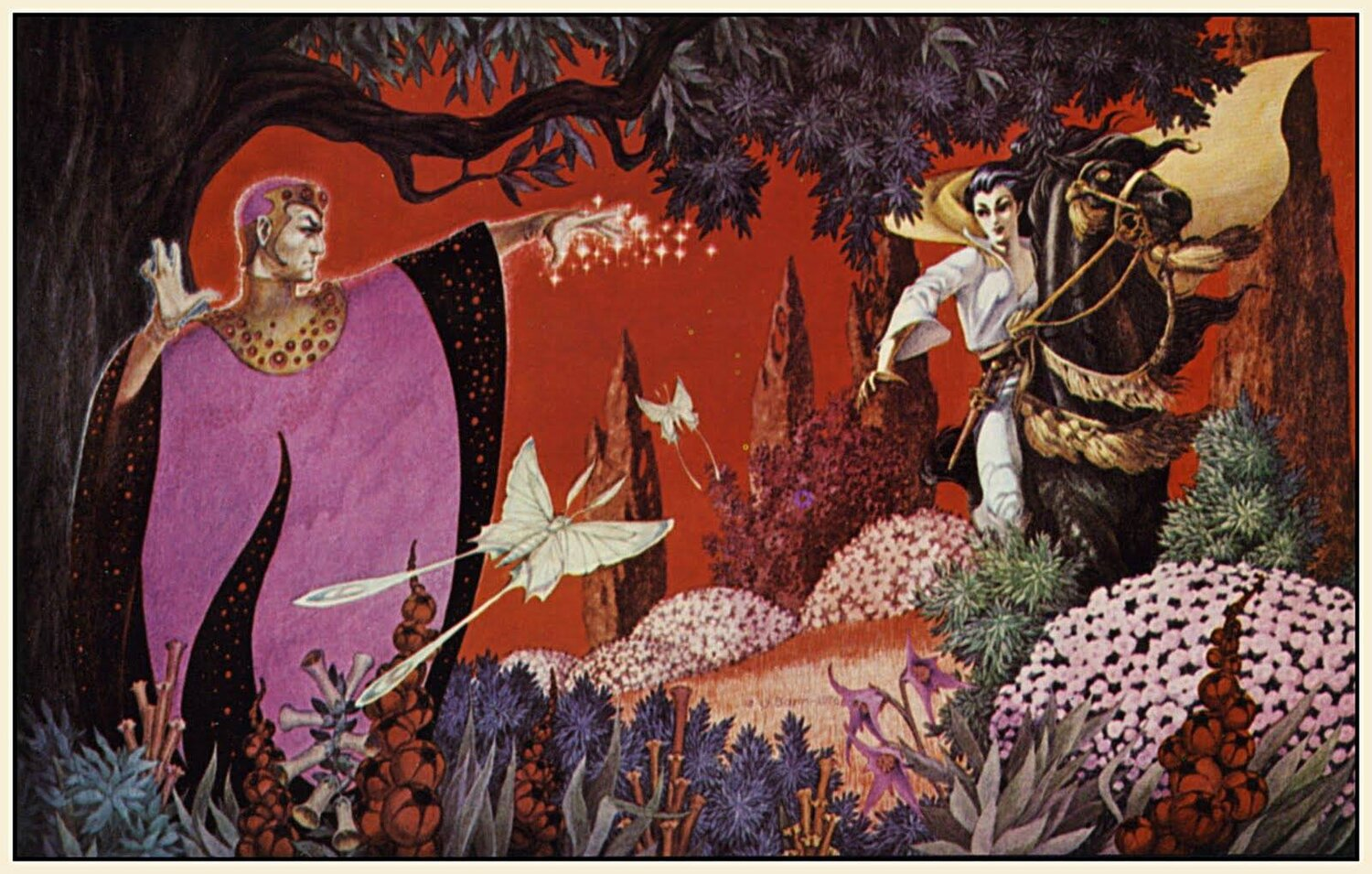
Wraparound cover for the 1976 Underwood-Miller hardcover edition of The Dying Earth, artwork by George Barr
When sci-fi and fantasy author Jack Vance passed away in 2013 at the age of 96 (with over 60 novels, 100 shorts, three Hugos and a Nebula Award to his name), Michael Moorcock told The Guardian, “For me there were two American fantasy writers who stood head and shoulders above the rest. One was Fritz Leiber and the other was Jack Vance.”
George R. R. Martin named a noble house of Westeros after him. Gene Wolfe cited him as a formative influence on his landmark Book of the New Sun series (1980-83). When Martin and Gardner Dozois compiled their 2009 tribute anthology Songs of the Dying Earth, Vance-fans-turned-fantasy-author-royalty queued up to heap praise and contribute: Robert Silverberg, Terry Dowling, Jeff VanderMeer, Tanith Lee, Neil Gaiman, Dan Simmons…
When it comes to 20th century fantasy fiction, few works have been as wildly influential and universally adored as Vance’s The Dying Earth stories, collected in a four-book sequence, The Dying Earth (1950), The Eyes of the Overworld (1966), Cugel’s Saga (1983) and Rhialto the Marvellous (1984).
Though his sci-fi output dwarfs that of his fantasy, Vance’s Dying Earth stories are among his best remembered works. Their longevity has much to do with Gary Gygax canonising the books in his famous ‘Appendix N’, a list of fantasy works that directly influenced the creation of Dungeons & Dragons. (Vecna – the celebrity D&D lich made famous by Stranger Things – is an anagram of ‘Vance’.)
However, readers picking up the first book in the series, perhaps to read a rollicking sword-and-sorcery adventure or to find out what fantasy looked like before Tolkien and D&D showed up, might find The Dying Earth more ‘hmmm…’ than ‘wow!’.
The book certainly benefits from a bit of historical context…